

Travel TipsIstanbul23 October 202612 min read
Turkish Evil Eye (Nazar): Meaning, Uses and Where to Buy One
Turkish evil eye explained: what the nazar bead means, Turkish or Greek, where to hang it, what a broken one means and where to buy handmade glass in Istanbul.
In this article
- What does the Turkish evil eye mean?
- Is the evil eye Turkish or Greek?
- How the beads are made: Görece and Nazarköy
- How to tell a handmade glass evil eye from a cheap copy
- Where to buy an evil eye in Istanbul
- How much does an evil eye cost in Turkey?
- Where to hang an evil eye, and other ways Turks use it
- What happens when an evil eye breaks?
- Is the evil eye religious?
- Travelling from abroad: bringing an evil eye home
- Frequently Asked Questions
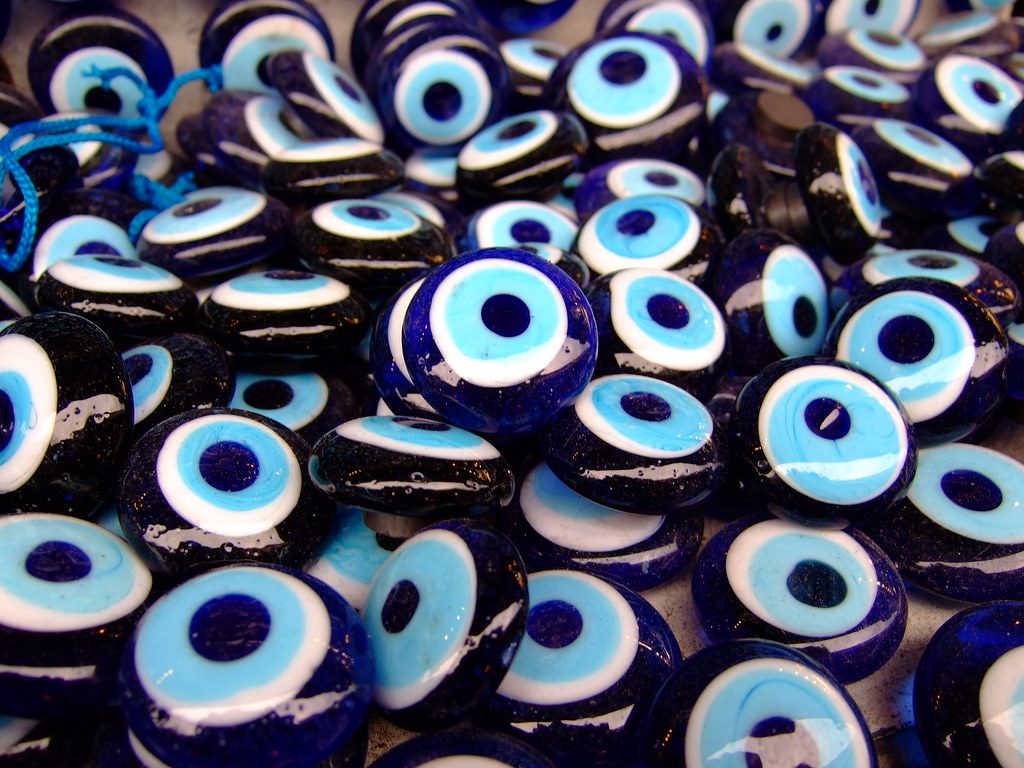
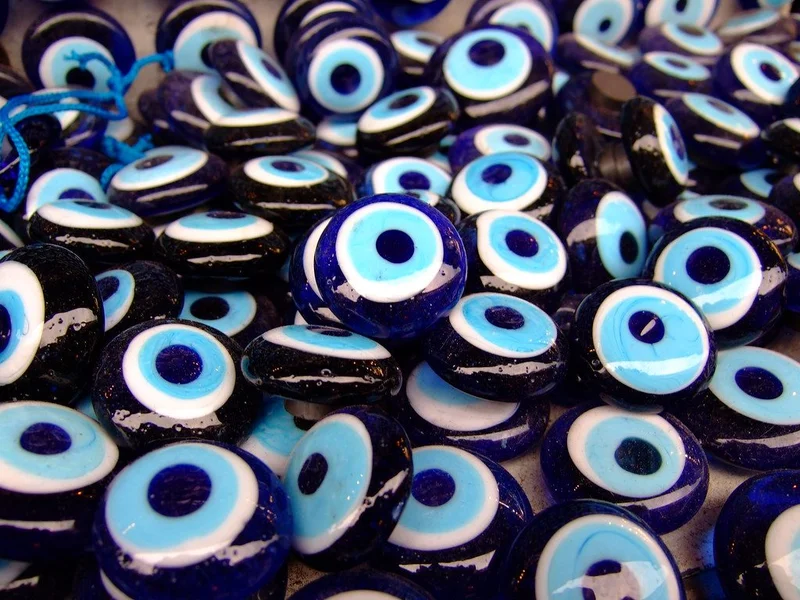
The Turkish evil eye, called nazar boncuğu in Turkish, is a blue glass bead with a white and dark-blue "eye" that is meant to catch envious or admiring looks before they can harm the person, home or business it protects. You will see it everywhere in Turkey: above doorways, on babies' clothes, hanging from taxi mirrors and set into the walls of new shops.
If you are in Istanbul now and want one to take home, the short version is this. Real handmade glass beads come mainly from two villages near İzmir, and you can buy them at the Grand Bazaar (closed on Sundays), the Spice Bazaar (open daily) and the craft shops around Sultanahmet and Galata. A small bead costs less than a cup of tea; a large hand-blown wall piece can cost several thousand lira. The rest of this guide explains what the bead means, how to use it the way Turks do, and how to spot a handmade one.
| Quick facts | Turkish evil eye |
|---|---|
| Turkish name | nazar boncuğu (nazar = gaze, boncuk = bead) |
| What it is for | to deflect envy and the "evil eye" |
| Traditional material | coloured glass, shaped by hand over a wood-fired kiln |
| Where handmade beads come from | Görece (Menderes) and Nazarköy (Kemalpaşa), both near İzmir |
| Where to buy in Istanbul | Grand Bazaar, Spice Bazaar, Arasta Bazaar, Galata and Kadıköy craft shops |
| What to say instead | "Maşallah" (what God has willed), said when praising a child or a new thing |
What does the Turkish evil eye mean?
The belief behind the bead is older than the bead. Across the Mediterranean, the Middle East and South Asia, people have long believed that a look full of envy, or even too much admiration, can bring bad luck: a baby falls ill after a neighbour praises its cheeks, a new car is scratched a week after a friend envied it, a shop that was full suddenly goes quiet. That harmful look is "the eye", nazar in Turkish, ayn in Arabic, mati in Greek.
The nazar boncuğu works by staring back. The idea is that the bead's eye meets the harmful gaze first and absorbs it. Blue is the traditional colour, and many Turks explain it simply: blue eyes were rare in Anatolia, so they were thought to carry the strongest gaze, and a blue eye is the best match for one.
You do not need to believe any of this to enjoy the bead. Many Turks hang one with a half-smile, the way people elsewhere knock on wood. But the custom is very much alive. Our guides are often handed a small bead by a shopkeeper as a thank-you, and new parents in Istanbul still receive dozens of tiny gold or glass eyes when a baby is born.
Is the evil eye Turkish or Greek?
Both, and neither. The belief in the evil eye is shared by Greece, Turkey, Cyprus, the Balkans, Iran, the Arab world, India and Pakistan, and it was recorded in the ancient world long before either modern country existed. Glass "eye beads" were made around the eastern Mediterranean for thousands of years.
What is distinctly Turkish is the flat blue glass nazar boncuğu made in the Aegean villages near İzmir, which became the standard design you now see in souvenir shops from Athens to Dubai. Greeks call their version the mati and hang it in much the same way. If someone at a dinner table in Istanbul and someone in Thessaloniki argue over whose it is, both will be partly right.
How the beads are made: Görece and Nazarköy
Most handmade nazar beads still come from two villages in İzmir province. Görece in the Menderes district and Nazarköy in Kemalpaşa are listed by the İzmir Provincial Directorate of Culture and Tourism as the places where beads are still produced by the traditional method. Nazarköy was called Kurudere until the late 2000s, when it was renamed after its craft.
The method is simple to describe and hard to do. Craftsmen build small round or oval kilns, fire them with pine wood, and melt coloured glass in the chambers. A master gathers a blob of molten dark-blue glass on an iron rod, turns it over a flat iron form, then adds white, light blue and black glass in rings to make the eye. Each bead is shaped by hand, so no two are exactly alike, and the quality depends on the master's skill. The Directorate lists traditional shapes with their own names, such as karagöz, walnut, cylinder, egg and plate.
The craft is shrinking. Factory-made beads from moulds, and plastic copies, are cheaper and now fill most souvenir stalls. If you are on an Ephesus tour from İzmir or Kuşadası, a short detour to Görece is possible with a private driver; tell us in advance and we can build it into the day, as on our Ephesus tour from İzmir.
How to tell a handmade glass evil eye from a cheap copy
You can usually tell in a few seconds, once you know what to look for.
- Weight and temperature. Glass is heavy for its size and feels cool in the hand. Plastic and resin are light and warm.
- Small irregularities. A handmade bead is slightly uneven: the rings are not perfectly centred, there may be a tiny air bubble, and the back may show the mark where it left the rod.
- The hole. Handmade beads have a hole formed around the iron rod, often a little rough at the edges. Moulded beads have a clean, uniform hole or a cast loop.
- Too perfect. Identical beads in a sealed packet, with sharp printed rings, are factory or printed.
- Ask. "El yapımı mı?" means "Is it handmade?" Honest sellers will tell you, because handmade and factory beads have their own prices and both sell.
None of this means a factory bead is a bad souvenir. If you need forty small charms for a wedding or office gifts, moulded glass is fine and much cheaper. Just pay a factory price for it.
Where to buy an evil eye in Istanbul
Istanbul has the widest choice in Turkey, and most of it is within walking distance of Sultanahmet.
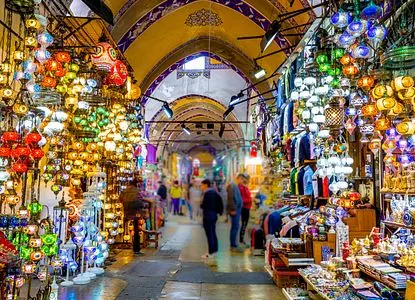
Grand Bazaar (Kapalıçarşı). Open Monday to Saturday from about 08:30 to 19:00 and closed on Sundays and on the first days of religious holidays. Nazar beads are sold in dozens of shops, from bead stalls near the Beyazıt gate to jewellers on Kalpakçılar Caddesi who set small glass or enamel eyes in gold and silver. For silver, look for a purity stamp (925); established jewellers on Kalpakçılar usually give a receipt. Our guide to Grand Bazaar opening hours and bargaining covers gates and timing.
Spice Bazaar (Mısır Çarşısı), Eminönü. Open every day, so it is the place to go on a Sunday. The shops in the side streets towards Tahtakale sell beads in bulk, which suits gift buyers.
Arasta Bazaar, behind the Blue Mosque. Quieter, mainly ceramics and textiles, but a few shops sell good glass and ceramic eyes at fixed prices.
Galata and Kadıköy. Design shops on the streets around Galata Tower and in Kadıköy's market area sell modern pieces, including designer jewellery with a nazar theme. Prices are higher but labelled.
Glass workshops. Some hotels and studios run evil eye or glass-blowing workshops where you watch, and sometimes help, make your own bead. The Mandarin Oriental on the Bosphorus, for example, lists an evil eye workshop for guests. Ask your hotel concierge whether one runs during your stay.
If you prefer to shop with someone who knows which shops sell handmade glass and what a fair price is, our private shopping tour of the Grand Bazaar and Spice Market costs from $90 for 6 hours with hotel pickup and a licensed guide. You are never obliged to buy, and you can walk away from any stall. Prices change with the season and group size; write to us for the price for your date.
How much does an evil eye cost in Turkey?
Prices in Turkey depend on size, material and where you buy. We cannot give a fixed lira price list because shop prices move with inflation, but the pattern is reliable.
| Type | Typical price level (October 2026) |
|---|---|
| Small factory glass bead or plastic charm | a few coins, often given free with a purchase |
| Handmade glass bead, 2 to 4 cm | low; a handful costs about the same as a simple lunch |
| Evil eye bracelet with glass beads | low to moderate, depending on the cord or chain |
| Silver (925) evil eye pendant or bracelet | moderate; priced mostly by the weight of the silver |
| Gold evil eye jewellery | priced by the gram at that day's gold rate, plus workmanship |
| Large hand-blown wall piece, 30 cm | about ₺2,600 to ₺2,900 at online Turkish retailers |
Bargaining is normal in the Grand Bazaar and expected for anything above a few beads. Start lower than the first price, stay friendly, and be ready to leave. In design shops and at fixed-price stalls in Arasta, the label is the price. Our guide on shopping in Istanbul and fair prices gives price ranges for carpets, ceramics, Turkish delight and other souvenirs.
Where to hang an evil eye, and other ways Turks use it
Turks put the nazar where something good might attract envy:
- At the entrance of a house or flat, hanging above or beside the front door, so it greets everyone who comes in.
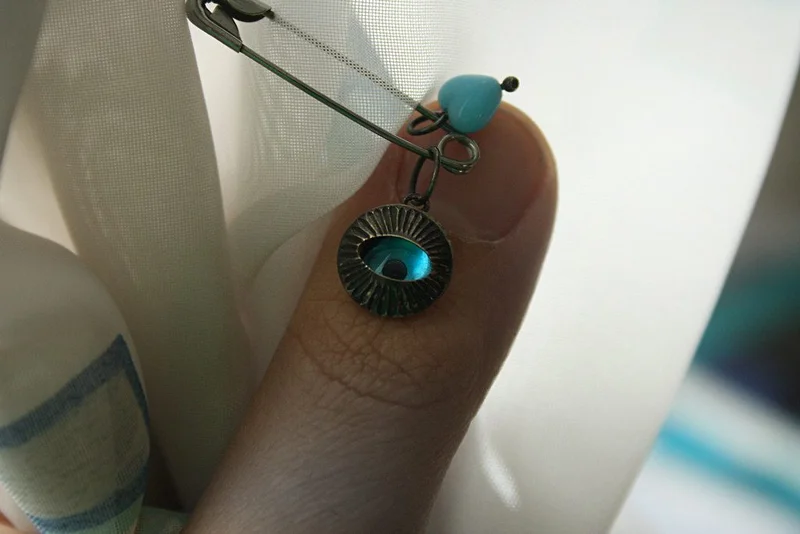
- On babies. A tiny gold or glass eye is pinned to a baby's clothes or pram with a safety pin; it is one of the most common gifts for a newborn.
- In cars and taxis, hanging from the rear-view mirror.
- In shops and offices, near the till or the door. Many new businesses in Istanbul open with a large glass eye on the wall.
- On jewellery, as a bracelet, pendant or ring.
- In gardens and on fruit trees, especially in villages, to protect a good harvest.
There is also a spoken side to the custom. When you admire a child, a house or someone's success, Turks add "Maşallah", and some knock twice on wood while saying "nazar değmesin" (may the eye not touch it). As a visitor, saying "Maşallah" when someone shows you a photo of their baby is warmly received.
What happens when an evil eye breaks?
In Turkish folk belief, a cracked or broken nazar has done its job: it took a strong harmful look that was aimed at you. You thank it, throw it away (some people bury it or drop it in running water) and replace it with a new one. It is not seen as bad luck. The same goes for a bracelet that snaps; the usual advice is to buy a new one rather than repair it.
A bead that slowly fades or loses its colour is simply old glass in the sun. Most families replace door beads every few years anyway.
Is the evil eye religious?
No. The nazar boncuğu is a folk custom, not a religious object. Belief in the evil eye itself appears in many religious traditions, including Islam, where it is mentioned in the hadith, but Islamic scholars in Turkey generally say protection comes from prayer and from saying "Maşallah", not from a bead. Some religious Turks avoid nazar beads for that reason; many others keep one out of habit and culture.
For visitors, the practical point is simple. You can wear or hang an evil eye whatever your faith, and nobody in Turkey will read anything into it. You will also see nazar beads in Christian, Jewish and secular homes across the region.
Travelling from abroad: bringing an evil eye home
The beads are the easiest souvenir in Turkey to carry. A few practical notes for the most common markets we see:
- USA, Canada and the UK. No customs issues for glass beads or jewellery for personal use. Wrap glass pieces in clothing in your hold luggage.
- India, Pakistan and the Gulf. Gold jewellery with an evil eye is a popular buy. Keep the receipt, as your home customs may ask about gold above their allowance.
- Europe. Within normal personal allowances there is nothing to declare for souvenirs bought in Turkey.
If you are planning the rest of your stay, our private Istanbul tours cover the Old City, the Bosphorus and the bazaars in one or several days, and our Istanbul shopping tour page lists the other shopping routes we run.
Frequently Asked Questions
What does the Turkish evil eye mean?
The Turkish evil eye, or nazar boncuğu, is a blue glass bead with an eye design that is believed to catch and absorb envious or harmful looks, protecting the person, home, car or business it is attached to. It is a folk custom found across Turkey, and many people keep one for luck and tradition rather than strict belief.
Is the evil eye Turkish or Greek?
The evil eye belief is shared by Turkey, Greece, the Balkans, the Middle East and South Asia and is far older than either modern country, but the flat blue glass nazar bead sold worldwide today comes mainly from Turkish villages near İzmir. Greeks call their version the mati and use it in much the same way.
Where do you hang an evil eye?
In Turkey people hang an evil eye at the front door of the house, in the car from the rear-view mirror, near the door or till of a shop, and pin a small one on a baby's clothes or pram. The idea is to place it where something good might attract envy, facing the people who come in.
What happens when an evil eye breaks?
In Turkish folk belief, an evil eye that breaks or cracks has absorbed a strong harmful look and done its job, so it is not a bad sign. People usually thank it, throw it away or bury it, and replace it with a new bead or bracelet instead of repairing the old one.
Is the evil eye religious?
The nazar bead is a cultural and folk custom, not a religious object, although belief in the evil eye appears in several religions, including Islam. Islamic scholars in Turkey generally teach that protection comes from prayer and saying "Maşallah", so some devout Turks avoid the beads while many others keep one by tradition.
Where can I buy a real evil eye in Istanbul?
You can buy real handmade glass evil eyes at the Grand Bazaar (Monday to Saturday, about 08:30 to 19:00), the Spice Bazaar in Eminönü (open daily), Arasta Bazaar behind the Blue Mosque and design shops in Galata and Kadıköy. Check for the weight, small irregularities and hand-formed hole that mark a handmade glass bead.
Written by the Get Istanbul Tours team: licensed local guides and trip planners based in Istanbul.
Leave a Comment
Private tours in Istanbul
Grand Bazaar & Spice Market Private Shopping Tour, Best Value
Shop the Grand Bazaar and the Spice Market with a local guide who knows the trusted vendors and fair prices.
Best of Istanbul Private Tour, 1-3 Days with Professional Guide
A licensed private guide for 1, 2 or 3 days in Istanbul: the Old City, the Bosphorus and the Golden Horn, planned around your interests.
Related articles
 Travel Tips
Where to Eat in Taksim 2027: Istiklal Street, Side Streets and What to Order, with Prices
Where to eat in Taksim: grill houses, meyhane streets, lokanta lunches and street food, with what to order and dinner costs of 1,200 to 3,000 TL.
Read More Itineraries
Istanbul 8 Day Itinerary 2027: Day by Day with Bosphorus, Islands, Bursa and Costs
Istanbul 8 day itinerary: Old City, Topkapi, Bosphorus, Princes' Islands and a Bursa day trip, with entrance fees and our 8-day private package from $1,499.
Read More Istanbul
Where to Eat in Beyoğlu 2027: Istiklal, Galata and Cihangir – Dishes, Prices, Streets
Where to eat in Beyoğlu by street and hour: Cihangir breakfast, Karaköy lunch and baklava, Nevizade meyhane dinner, with reported 2026 prices and a food tour from $90.
Read More