


Travel TipsIstanbul3 October 202612 min read
Shopping in Istanbul: What to Buy, Where, and What Is a Fair Deal
Grand Bazaar closed Sundays, Spice Bazaar open daily: what is worth buying, how bargaining works, paying in lira, tax-free forms and carpet export rules.
In this article
- Shopping in Istanbul: the short version
- Opening hours for shopping in Istanbul, and the Sunday trap
- What to buy in Istanbul, and what to skip
- The Grand Bazaar: how to move through 4,000 shops
- Grand Bazaar bargaining: how it actually works
- The Spice Bazaar: what to buy and what to leave
- Paying: lira, cards and the euro price
- Carpets and antiques: the export rule that catches people
- Beyond the bazaars: where residents shop
- When a guided shopping morning is worth it
- Frequently Asked Questions
The best shopping in Istanbul fits into one morning and two tram stops: the Grand Bazaar at Beyazıt-Kapalıçarşı and the Spice Bazaar at Eminönü, ten minutes apart on the T1 line. The thing most visitors get wrong is the day. The Grand Bazaar is closed on Sundays, while the Spice Bazaar stays open seven days a week, so a Sunday plan to "do the bazaars" ends at a locked gate.
This guide is for people already in the city who want to buy something this week without overpaying. It covers what is worth carrying home, where each thing is sold, how bargaining really works, how to pay, and the two pieces of paperwork that matter: the tax-free form and the carpet export certificate. Opening hours are as published in 2026; small shops keep their own hours inside them, so treat the times as a frame, not a promise.
Shopping in Istanbul: the short version
| What you want | Where to go | Bargain? |
|---|---|---|
| Lamps, copper, ceramics, leather, jewellery | Grand Bazaar (closed Sundays) | Yes |
| Spices, tea, dried fruit, nuts, Turkish delight | Spice Bazaar, Eminönü (open daily) | Little, often fixed by weight |
| Boxed Turkish delight and baklava to fly home | Long-running confectioners in Eminönü, Sirkeci and Karaköy | No, fixed prices |
| Textiles and towels at local prices | Mahmutpaşa streets between the two bazaars | A little |
| Brands, chain stores, a rainy afternoon | Malls such as İstinye Park and Zorlu Center, or Nişantaşı's streets | No |
| Food the way residents buy it | Kadıköy's market streets on the Asian side | No |
If you only have half a day, start at the Grand Bazaar when it opens, walk downhill through Mahmutpaşa to the Spice Bazaar, and finish at the Eminönü ferry piers. The whole walk is about 20 minutes without stops, and it is downhill all the way.
Opening hours for shopping in Istanbul, and the Sunday trap
The Grand Bazaar (Kapalıçarşı) opens Monday to Saturday from about 08:30 or 09:00 to 19:00. It is closed on Sundays and on the first days of the two religious holidays, Ramadan Bayram and Kurban Bayram. Entry is free, through any of its main gates; the Beyazıt and Nuruosmaniye gates are the two most visitors use. For the exact 2027 Eid dates when both bazaars stay shut, see our list of Turkey public holidays 2027. Gates, tram stops and a two-hour route are in our guide to the Grand Bazaar Istanbul.
The Spice Bazaar (Mısır Çarşısı) is open every day. Weekday hours run from about 08:00 to 19:30; on Sundays it opens later, at about 09:30, and closes around 19:00.
Three practical consequences:
- On a Sunday, go to the Spice Bazaar and Kadıköy, and keep the Grand Bazaar for Monday.
- Before 10:00, some shops in the Grand Bazaar are still rolling up their shutters. Mid-morning is when nearly every stall is open and the cruise groups have not yet arrived.
- Saturday afternoons are the most crowded time in both bazaars, because Istanbul residents shop then too.
What to buy in Istanbul, and what to skip
These are the things that are genuinely made or traded here, sell at fair prices when you shop carefully, and survive a suitcase:
- Turkish delight (lokum), bought fresh by weight and vacuum-packed for the flight.
- Spices and tea: sumac, pul biber (Aleppo-style chilli flakes), dried mint, saffron only from a shop you trust, and Black Sea tea or apple tea.
- Dried fruit and nuts: dried apricots, figs and Antep pistachios.
- Mosaic glass lamps, sold flat-packed with the fittings for your country if you ask.
- Copper and brass: coffee pots (cezve), trays and bowls. Ask whether a pot is lined with tin for cooking or decorative only.
- Ceramics with İznik-style patterns: bowls, tiles and plates.
- Peshtemal towels: thin, flat-woven cotton hammam towels that dry fast and pack small.
- Leather jackets and bags, best from a shop that makes them and can alter the fit the same day.
- Carpets and kilims, if you are ready to spend time and read the export rules below.
What to skip: "saffron" sold cheaply in big open sacks (often safflower), branded watches and handbags in back alleys (copies, and illegal to bring into most countries), and loose spice mixes sold as "love tea" or "Viagra spice" at inflated per-gram prices. Pashminas sold as pure silk at low prices are usually viscose.
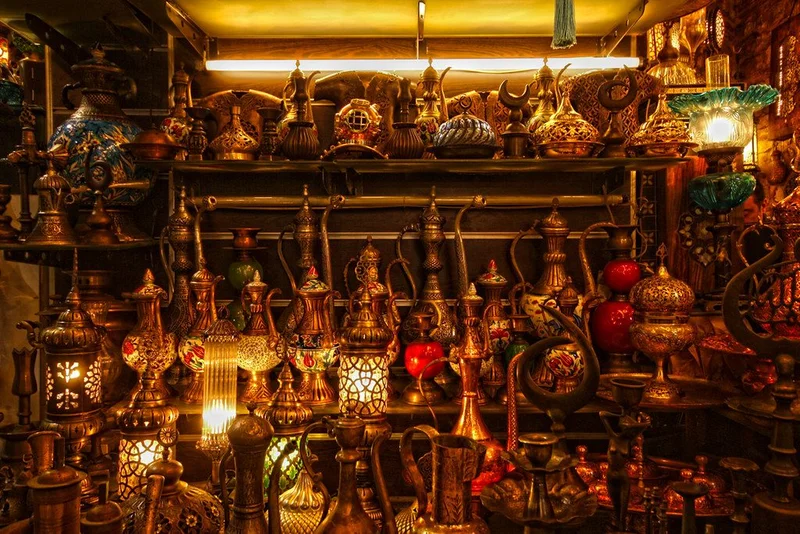
The Grand Bazaar: how to move through 4,000 shops
The Grand Bazaar has grown since the 15th century into a covered town of roughly 4,000 shops along dozens of streets. Trades still cluster, which helps:
- Jewellers and gold line Kalpakçılar Caddesi, the main street running from the Beyazıt Gate. Gold is sold by weight plus a workmanship charge; the gram price of the day is usually shown on a screen.
- Carpets sit in the older inner sections and the small hans (courtyard workshops) around the edges.
- Lamps, ceramics and souvenirs are everywhere near the Nuruosmaniye side, which is the busiest and the most expensive.
- Leather is concentrated in a few streets close to the centre.
Two habits save time and money. First, walk one full loop before you buy anything; the same lamp appears in twenty shops at different prices. Second, note where you are by gate number, because the bazaar's streets bend and phone maps lose their signal under the roof.
Grand Bazaar bargaining: how it actually works
There is no fixed percentage to knock off. Anyone who tells you "always offer half" is guessing. What is true:
- Bargaining is expected on lamps, ceramics, carpets, leather, copper and souvenirs in the Grand Bazaar. It is not expected on food sold by weight with a printed price, or in chain shops and malls. If someone you just met offers to walk you to a cousin's carpet shop, read our list of common Istanbul scams first.
- Decide your price before you ask theirs. If you would happily pay a certain amount, that is your ceiling. Open below it and move up slowly.
- Buying several items from one shop is the strongest lever you have. Two lamps and a bowl from one shopkeeper will cost less than the same three things from three shops.
- Cash in lira can bring the price down a little, because it saves the shop the card commission.
- Walking away politely works. Say teşekkürler (thank you), and leave. If your price was reasonable, you will often be called back. If you are not, the price was close to the floor.
Tea will be offered. Accepting a glass does not oblige you to buy. Saying no to the tea is also fine.
The Spice Bazaar: what to buy and what to leave
The Spice Bazaar is an L-shaped 17th-century hall at Eminönü, next to the New Mosque and a few minutes from the ferry piers. It is smaller than the Grand Bazaar and easier to manage in an hour.

As for what to buy at the Spice Market: spices, tea, dried fruit, nuts, Turkish delight and pestil (sheets of dried fruit leather). Most stalls sell by weight with prices per kilo on the label, so the bargaining is gentle. Ask for 100 or 250 grams rather than accepting a pre-filled box, and ask for vacuum packing (vakumlu), which most stalls do free for spices and lokum.
The best value is often just outside. The streets on the west side of the hall, towards Tahtakale, are where residents buy coffee, cheese, olives and spices, at prices written for locals. Kurukahveci Mehmet Efendi, the coffee roaster founded in 1871, is on the corner there; the queue moves fast, and ground Turkish coffee is a light, practical gift.
Where to buy Turkish delight that is actually fresh
Lokum sold in tourist shops in pretty boxes is often old and sugary. Fresh lokum is soft, slightly elastic and dusted with starch or coconut, and it is sold by weight from trays.
Two names have been at it for longer than most countries have existed:
- Hacı Bekir, founded in 1777, with its historic shop on Hamidiye Caddesi in Eminönü, a two-minute walk from the Spice Bazaar.
- Hafız Mustafa 1864, with branches in Sirkeci, Eminönü and on Divanyolu, which also sells baklava in tins for travelling.
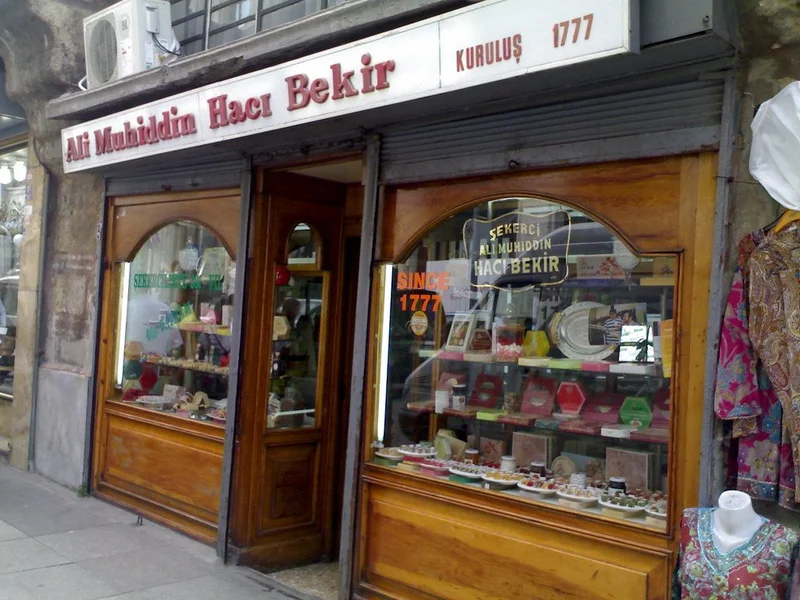
Buy lokum on your last or second-to-last day. Rose and plain flavours keep longest; pistachio and double-roasted versions are the ones people come back for. Baklava travels for a couple of days in a sealed tin but is best eaten in the city.
Paying: lira, cards and the euro price
- Cards are accepted in most established shops in both bazaars, in malls and in confectioners. Small stalls, tea sellers and street carts want cash.
- When a card terminal asks whether to pay in your home currency or in lira, choose lira. The conversion offered at the terminal usually uses a poor rate.
- Prices quoted in euros or dollars are common in the Grand Bazaar. Ask for the lira price as well and compare; paying in lira is normally cheaper.
- Cash machines are at the bazaar gates. Bank-branded machines usually charge lower fees than the independent ones on the main tourist streets.
For getting around between the shopping areas, our guide to Sultanahmet to Taksim by tram, funicular or taxi covers the T1 tram, the Istanbulkart and taxi fares.
Tax-free shopping and the refund at the airport
Non-residents can reclaim the VAT (KDV, 20% on most goods) on purchases they take out of Turkey within three months. It works only in shops that display a Tax Free sticker, and only above a minimum spend per receipt, which each shop applies and which changes with inflation. Ask at the till before you pay.
How it works in practice:
- Show your passport at the till and ask for the tax-free form.
- At the airport, have the form and the goods checked by customs before check-in if the goods will go in your hold luggage.
- Claim the refund at the refund desk airside, in cash or to your card, minus a service fee.
Small purchases in the bazaars rarely qualify, because the individual stalls are not usually part of the scheme. It matters for jewellery, leather and carpets. The airport steps, the 1,000 TL minimum and a worked refund example are in our guide to tax free shopping in Turkey.
Carpets and antiques: the export rule that catches people
Turkey forbids taking antiquities and cultural property out of the country without permission. For carpets, the line most dealers and customs officers use is age: a carpet considered antique, generally around a century old or more, needs an export certificate from a museum directorate. The penalties for getting this wrong are serious.
For a new or recent carpet, keep the invoice. Reputable carpet shops provide the paperwork confirming that a piece is not an antique and can be exported; ask for it before you pay, not after. Shops can also ship a carpet home; ask what insurance and customs charges at your end are included, because import duty in your country is usually not.
If you are not sure you want a carpet, do not sit through a long carpet presentation. It is pleasant and the tea is good, but it is a sales room.
Beyond the bazaars: where residents shop
Some of the most relaxed shopping in Istanbul happens away from the two historic markets, in neighbourhoods where nobody calls you into a shop.
- Mahmutpaşa, the steep streets between the two bazaars, is where Istanbul families buy towels, scarves, kitchenware and children's clothes. It is crowded and noisy, with prices written for locals.
- Kadıköy, a 20-minute ferry ride from Eminönü or Karaköy to the Asian side, has market streets of fish, cheese, pickles, olives and coffee around the pier. It is a better food-shopping afternoon than any souvenir street. Our Istanbul tours by locals page covers guided walks there and in Balat.
- Nişantaşı is the city's main area for Turkish and international designer shops, a short taxi ride from Taksim.
- Malls like İstinye Park and Zorlu Center have fixed prices, cafés and clean toilets, and they are the right answer on a cold or wet day.
When a guided shopping morning is worth it
Shopping in Istanbul on your own is easy if you want a lamp and a box of lokum. A guide earns their fee when you are buying something expensive, such as a carpet, gold or a made-to-measure leather jacket, and want someone who speaks the language, knows which shops have been trading honestly for decades and is not paid by the shop.
Our private shopping tour of the Grand Bazaar and Spice Market lasts four hours, starts and ends at your hotel, and includes a licensed guide and drink samples. Only your group takes part. It does not run on Sundays, because the Grand Bazaar is closed, and it suits strollers but not wheelchairs. It is listed from $150 per group; prices change with the date, group size and whether you add a private van, so write to us for the price on your day. Same-day and next-day requests on WhatsApp are often possible.
If you would rather see the bazaar as part of the sights, our small-group afternoon tour of Topkapı, Hagia Irene and the Grand Bazaar runs six hours with hotel or Galataport pickup. Lunch near the bazaar is covered in our guide on where to eat in Sultanahmet. All our guided options are on the Istanbul tours page, and the Istanbul destination page covers the city by district.
Who should skip a guided shopping tour: people who enjoy wandering and haggling, and anyone whose shopping list is spices, tea and sweets. For that, the Spice Bazaar and the streets around it are enough.
Frequently Asked Questions
Is the Grand Bazaar open on Sunday?
No. The Grand Bazaar is closed on Sundays and on the first days of the religious holidays. It opens Monday to Saturday from about 08:30 or 09:00 to 19:00. The Spice Bazaar at Eminönü is open on Sundays, from about 09:30.
What is the best thing to buy in Istanbul?
Fresh Turkish delight bought by weight, spices and tea from the Spice Bazaar, peshtemal towels, mosaic glass lamps and copper coffee pots are the most popular buys that pack well. Carpets and leather are worth it if you have time to compare shops.
How much should I bargain in the Grand Bazaar?
There is no fixed rule. Decide what the item is worth to you before asking the price, open below that and move up slowly. Buying several items in one shop and paying cash in lira give you the most room. Food with printed prices per kilo is not bargained.
Can I pay by card in the Grand Bazaar?
Yes, most established shops take cards. Small stalls want cash in lira. When the terminal offers your home currency, choose lira, which is usually cheaper. Cash machines are at the main gates.
Can I take a Turkish carpet home?
Yes, if it is not an antique. Keep the invoice and ask the shop for the document confirming the carpet is not an antiquity. Carpets considered antique, generally about a century old or more, need an export certificate from a museum directorate.
Can tourists get a tax refund in Turkey?
Yes, at shops displaying a Tax Free sign, above each shop's minimum spend per receipt. Ask for the form with your passport at the till, have it stamped by customs at the airport before check-in, and claim the refund at the desk airside.
Written by the Get Istanbul Tours team: licensed local guides and trip planners based in Istanbul.
Leave a Comment
Private tours in Istanbul
Grand Bazaar & Spice Market Private Shopping Tour, Best Value
Shop the Grand Bazaar and the Spice Market with a local guide who knows the trusted vendors and fair prices.
Topkapi (Ticket Included), Hagia Irene & Grand Bazaar Tour
A small-group Old City tour of Topkapi Palace (ticket included), the Hagia Irene Museum and the Grand Bazaar, with hotel pick-up.
Related articles
 Where to Stay
 in Istanbul with Kids (2027): 7 Family Areas Ranked, with Tour Pickup Notes
Sultanahmet for a first family trip, Beşiktaş or Nişantaşı for longer stays: seven Istanbul areas ranked for strollers, quiet nights, parks and tour pickup.
Read More Where to Stay
 in Istanbul for New Year's Eve 2027: 6 Areas Ranked
Six Istanbul areas ranked for New Year's Eve: fireworks views, getting home after midnight, noise, and the cruise or yacht plan that fits each one.
Read More Prices & Costs
Private Tour vs Group Tour in Istanbul: 2027 Prices for 1 to 6 People
Group tours win for solo travellers, couples come out about even, and private guides win from three people up. Our 2027 prices for 1 to 6 travellers, tickets counted.
Read More