

 Istanbul
Basilica Cistern (Yerebatan)
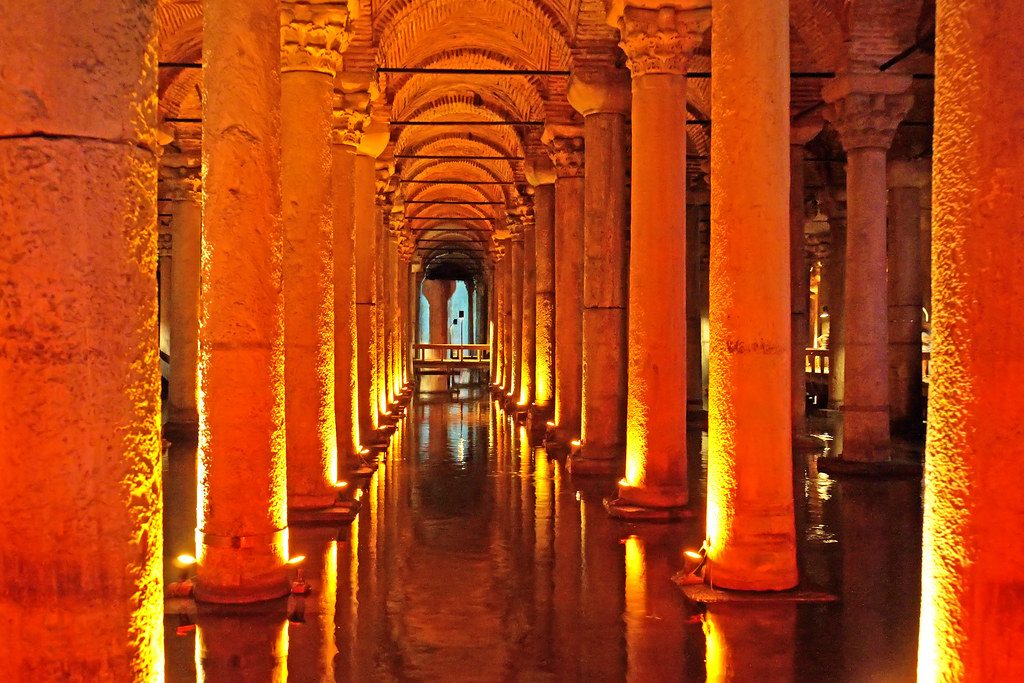
The Basilica Cistern is a 6th-century underground water reservoir held up by 336 marble columns, with two Medusa heads at its far corner. It is lit dramatically, cool in summer and one of the few Istanbul sights that stays open late into the evening.
Tours that visit Basilica Cistern
Best of Istanbul Private Tour, 1-3 Days with Professional Guide
A licensed private guide for 1, 2 or 3 days in Istanbul: the Old City, the Bosphorus and the Golden Horn, planned around your interests.
Private Basilica Cistern Tour, Optional Topkapi & Hagia Sophia
The Basilica Cistern with your own licensed private guide and the entrance ticket included, with optional Topkapi Palace and Hagia Sophia visits.
Under a plain brick building on Yerebatan Street, a flight of stairs takes you down into a hall the size of a large church, lit orange and reflected in shallow water. The Basilica Cistern was built in 532 to store water for the Great Palace of the Byzantine emperors. Today it is the most visited sight in Istanbul that you can finish in under an hour.
Quick facts
| Item | Details |
|---|---|
| Opening hours | Day session 09:00-18:30, evening session 19:30-22:00, with a break in between (as of October 2026) |
| Closed | Open daily |
| Ticket for foreign visitors | 1,950 TL for the day session, 3,000 TL for the evening session (as of October 2026). The Museum Pass is not valid here |
| Time needed | 30-45 minutes |
| Location | Yerebatan Caddesi, Sultanahmet, 150 metres from Hagia Sophia. Tram T1 to Sultanahmet |
| Dress code | None. Bring a light layer; it is cool and humid underground |
The cistern is run by the Istanbul Metropolitan Municipality, not by the Ministry of Culture, which is why national museum cards do not work. Card payment is the norm at the ticket office.
A short history
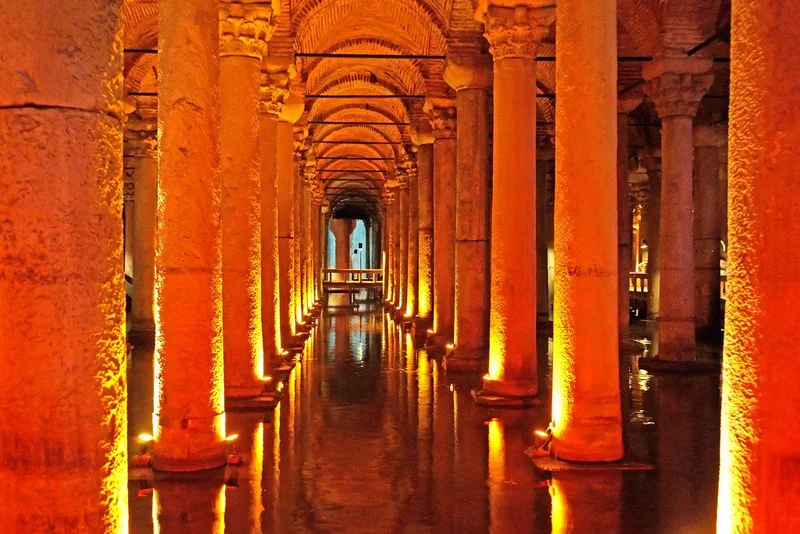
Justinian's engineers built the cistern on the site of an older basilica, which gave it its name. Water came from the Belgrade Forest north of the city through aqueducts. The reservoir measures about 138 by 65 metres, and its 336 columns stand in 12 rows, many of them reused from older buildings, which is why capitals and shafts do not match. After the Ottoman conquest it was half-forgotten; a French traveller in the 16th century found locals lowering buckets through holes in their basements. A long restoration closed it from 2017 until 2022, when it reopened with new lighting, raised walkways and contemporary art installed among the columns.
What to see inside
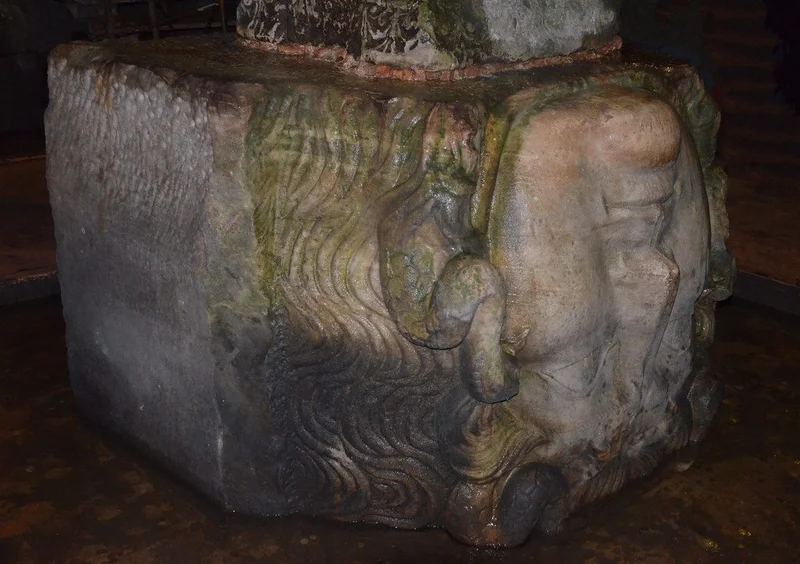
- The Medusa heads, at the far north-west corner. Two blocks carved with Medusa's face serve as column bases, one on its side and one upside down. Nobody knows for sure why; the likeliest answer is that builders simply used them as spare stone.
- The Weeping Column, carved with teardrop and peacock-eye patterns and usually wet. Visitors put a thumb in its hole for luck.
- The column forest itself. Stand in the middle of the walkway and look along a row; the reflections double the length.
- Art installations that change from time to time among the columns.
Day or evening?
The evening session costs more and is shorter, but the crowds are thinner and it fits after a day of other sights. The day session is cheaper and is busiest between 10:30 and 15:00, when tour groups come down after Hagia Sophia. The first half-hour after 09:00 is the quietest time of all.
The queue outside can reach 40 minutes in summer. Online tickets from authorised sellers help. Our Private Topkapi Palace & Basilica Cistern Tour ends here with fast-track entry after four to five hours at the palace.
Tips
- The walkways are wet in places. Wear shoes with grip.
- It is dark; phone photos work, but hold still. Tripods and flash are not welcome.
- Temperature underground is lower than outside even in August, so the cistern is a good midday stop in the heat.
- There are steps at the entrance and exit, and the exit is on a different street from the entrance. Agree a meeting point if your group splits.
- Pushchairs are awkward on the stairs. A baby carrier is easier.
- If the queue is too long, the smaller Serefiye Cistern, a ten-minute walk away, is a quieter alternative with a lower ticket price.
For more to see around Sultanahmet, go to our Istanbul destination page.
Frequently Asked Questions
How much does the Basilica Cistern cost in 2026?
Foreign visitors pay 1,950 TL for the day session and 3,000 TL for the evening session. The Museum Pass Istanbul does not cover it.
How long do you need at the Basilica Cistern?
Thirty to 45 minutes is enough to walk the whole route and see the Medusa heads. Add queue time if you arrive between late morning and mid-afternoon.
Why are the Medusa heads upside down?
No written source explains it. The common view is that the carved blocks were taken from an older building and placed sideways and upside down simply to fit as column bases.
Is the Basilica Cistern worth visiting?
For most people it is, especially on a hot day. It is short, close to Hagia Sophia and unlike anything else in the city. Travellers on a tight budget may prefer the cheaper Serefiye Cistern.
Can you visit the Basilica Cistern at night?
Yes. An evening session runs from 19:30 to 22:00 with a separate, higher-priced ticket.
More places to see in Istanbul
- Balat and Fener (Fener and Balat)
- Beylerbeyi Palace
- Blue Mosque (Sultanahmet Mosque)
- Bosphorus Strait (Bosphorus Cruise)
- Camlica Hill and Camlica Mosque
- Chora Church (Kariye Mosque)
- Dolmabahce Palace
- Emirgan Park
- Fatih Mosque
- Fener Greek Orthodox Patriarchate (Aya Yorgi)
- Galata Bridge and Eminonu
- Galata Tower
- Grand Bazaar (Kapalıçarşı)
- Hagia Irene (Aya Irini)
- Hagia Sophia (Ayasofya)
- Hippodrome of Constantinople (Hippodrome Square)
- Istanbul Archaeology Museums
- Istanbul Modern
- Istiklal Avenue and Taksim (Istiklal Street)
- Kadikoy and Moda
- Little Hagia Sophia (Kucuk Ayasofya)
- Maiden's Tower (Kız Kulesi)
- Miniaturk
- Nuruosmaniye Mosque
- Ortakoy Mosque (Buyuk Mecidiye Mosque)
- Pera Museum
- Pierre Loti Hill and Eyup Sultan Mosque
- Princes' Islands (Adalar)
- Rumeli Fortress (Rumelihisarı)
- Rustem Pasha Mosque
- Spice Bazaar (Egyptian Bazaar)
- Suleymaniye Mosque
- Sultanahmet Square
- Topkapi Palace
- Turkish-Islamic Arts Museum (Ibrahim Pasha Palace)
- Yildiz Palace and Yildiz Park