

 Ephesus
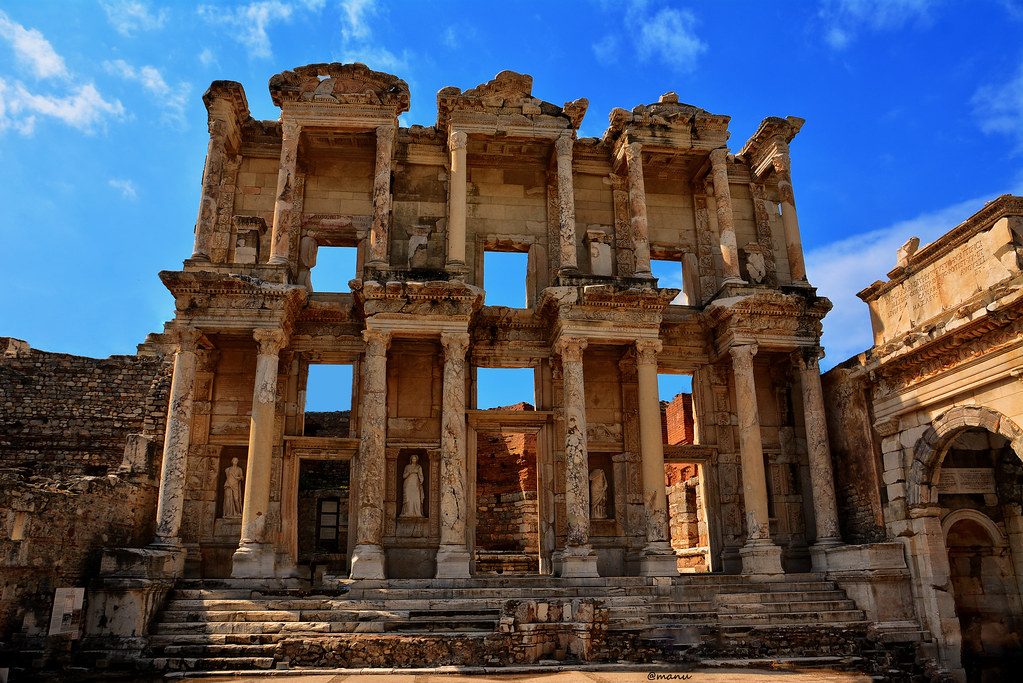
Library of Celsus
The Library of Celsus is the two-storey marble facade at the heart of Ephesus, built in the early 2nd century AD as a library and a tomb for a Roman governor. It is included in the Ephesus ticket, €40 for foreign visitors in 2026.
Tours that visit Library of Celsus
Ephesus Full-Day Private Tour with Skip-the-Line Entry
A private full day in Ephesus with an expert guide, from the Library of Celsus to the House of the Virgin Mary.
Ephesus & Pamukkale 2-Day Tour: Flights & Lunch Included
Two days from Istanbul to Ephesus and Pamukkale with flights, a night in a Pamukkale hotel, a licensed guide, entrance fees and lunches.
The Library of Celsus is the picture on almost every Ephesus postcard, and it deserves the attention. Its two-storey facade of columns, niches and statues stands at the bottom of Curetes Street, where the marble road turns towards the harbour. It was built in the early 2nd century AD, and it was both a public library and a monumental tomb. There is no separate ticket: it is part of the Ephesus site, which costs €40 for foreign visitors in 2026.
Quick facts
| Item | Details |
|---|---|
| Opening hours | Ephesus site 08:00-18:00, ticket office closes at 17:30 (as of October 2026, muze.gov.tr) |
| Closed | Open every day |
| Ticket | Included in the €40 Ephesus ticket (as of October 2026); the Museum Pass is valid |
| Time needed | 15-20 minutes at the library; 2.5-3 hours for Ephesus |
| Location | Lower part of Ephesus, near the Lower (North) Gate |
| What to wear | Shoes with grip; the marble paving is slippery |
A short history
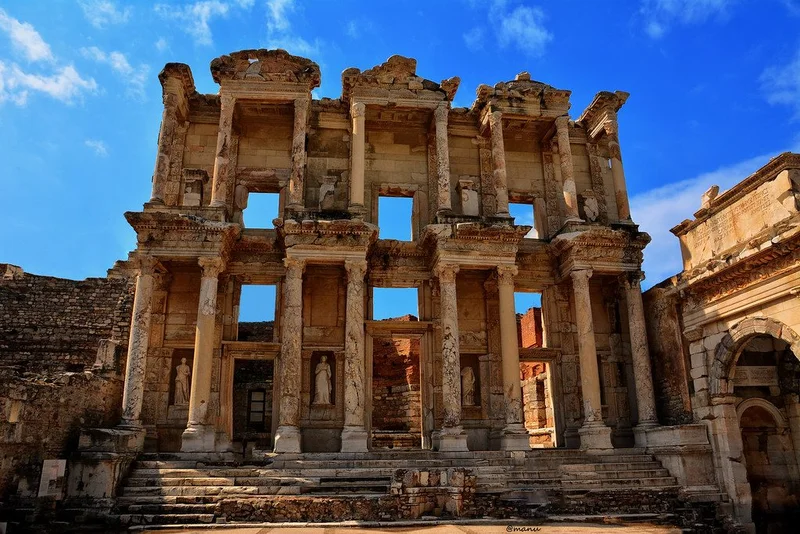
Tiberius Julius Celsus Polemaeanus was a Greek from Sardis who rose to be a Roman consul and governor of the province of Asia, whose capital was Ephesus. After his death, his son, Tiberius Julius Aquila, paid for a library in his honour, completed around 117 AD. Celsus was buried in a marble sarcophagus in a chamber beneath the building, an unusual honour inside a city.
The library held around 12,000 scrolls in wall niches, with a double wall to protect them from damp. It was one of the largest libraries of the Roman world. Its interior burned in the 3rd century, probably during an earthquake or a Gothic raid, and later earthquakes brought down the facade. In the 1970s the Austrian Archaeological Institute re-erected the front from the original pieces, filling gaps with new stone. The work took from 1970 to 1978.
What to see
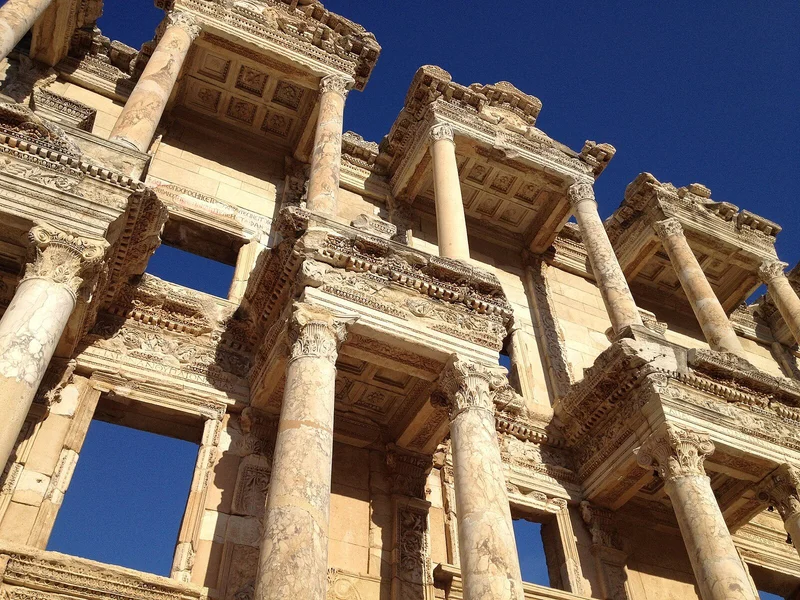
- The facade. Two storeys of paired columns with alternating pediments, arranged with clever tricks of perspective: the outer columns are slightly shorter, so the front looks wider and taller than it is.
- The four virtues. Statues in the lower niches represent Wisdom (Sophia), Virtue (Arete), Thought (Ennoia) and Knowledge (Episteme). They are copies; the originals are in the Ephesos Museum in Vienna.
- The inscriptions. Greek and Latin texts on the steps and walls name Celsus and his son.
- The Gate of Mazaeus and Mithridates. The triple gateway beside the library, built by two freed slaves in honour of the Emperor Augustus, leading into the commercial agora.
- The inside. The interior is an open shell now, but you can see the niches where scrolls were kept.
Best time to visit
The library faces east, so early morning light falls straight on the facade. That is also when the site is quietest, before cruise groups from Kusadasi arrive around 09:30. From late morning until early afternoon the square in front is packed. Late afternoon, after 16:00, is calmer again, but the facade is in shade.
Our Private Ephesus Highlights Tour with Skip-the-Line Access covers the Library of Celsus, the Terrace Houses and the House of the Virgin Mary with an expert guide, from US$300. From Istanbul, the Ephesus Day Trip from Istanbul with Flights flies to Izmir and back in one day. Cruise passengers can use the Private Ephesus Tour with On-Time Return, from US$300.
How the library worked
Readers entered through the three doorways at the top of the steps into a single tall hall. The scrolls sat in rectangular niches set into the walls on several levels, reached by galleries, and a gap of about a metre between the inner and outer walls kept out moisture, a sensible design in a city by the sea. A large apse opposite the entrance probably held a statue of Celsus or of Athena, goddess of wisdom. Readers took the scrolls to tables in the hall rather than borrowing them.
Libraries in the Roman world were public buildings meant to display the generosity of rich families, and this one sat at the busiest crossroads of the city, beside the agora and the main street to the harbour.
Photo tips
- Stand on Curetes Street as you walk down for the classic view from above.
- For a full-frame shot without people, arrive at opening time and walk straight down from the Upper Gate.
- A wide lens helps; the square in front is narrow.
- Detail shots of the capitals and cornices reward a zoom.
More about the ancient city is on our Ephesus Ancient City page and our Ephesus and Kusadasi destination page.
Frequently Asked Questions
Do I need a separate ticket for the Library of Celsus?
No. It is inside Ephesus and included in the main site ticket, €40 for foreign visitors as of October 2026.
How old is the Library of Celsus?
It was completed around 117 AD, so it is about 1,900 years old. The facade was re-erected in the 1970s.
How many books were in the Library of Celsus?
It is estimated to have held about 12,000 scrolls, which made it one of the largest libraries of the Roman world.
Is Celsus buried in the library?
Yes. His marble sarcophagus lies in a chamber beneath the building, which is not open to visitors.
Are the statues at the Library of Celsus original?
No. The four statues of the virtues are copies; the originals were taken to Vienna and are in the Ephesos Museum there.